

Did you know the global content marketing industry is projected to surpass $100 billion in revenue this year? Even with that massive spend, many businesses still struggle to build content marketing strategies that actually generate leads. You’ve likely spent hours on posts that get zero engagement whilst feeling like your brand voice is a mess across different platforms. It’s frustrating when you can’t measure the actual ROI of your hard work.
We’ve got you. This guide is your no-nonsense roadmap to creating a result-driven plan that attracts and converts your ideal audience. We’ll show you how to generate 67% more leads through strategic blogging and stay compliant with the EU AI Act transparency rules starting 2 August 2026. You’ll gain a documented plan that secures higher search engine rankings and maps out every stage of the buyer journey. Let’s get your digital presence working as hard as you do.
Key Takeaways
- Move from “chaos content” to a precision roadmap by building content marketing strategies that drive measurable business growth.
- Learn to identify your customers’ real frustrations and build a brand voice that makes your business the obvious choice amongst competitors.
- Master the mix of punchy short-form video and long-form blogs to dominate search results and social feeds simultaneously.
- Follow a clear, two-step execution plan to audit your existing assets and set SMART goals that actually impact your bottom line.
- Stop wasting time on vanity metrics and start tracking the lead quality and conversion rates that signal true success.
What are Content Marketing Strategies and Why Do Most Fail?
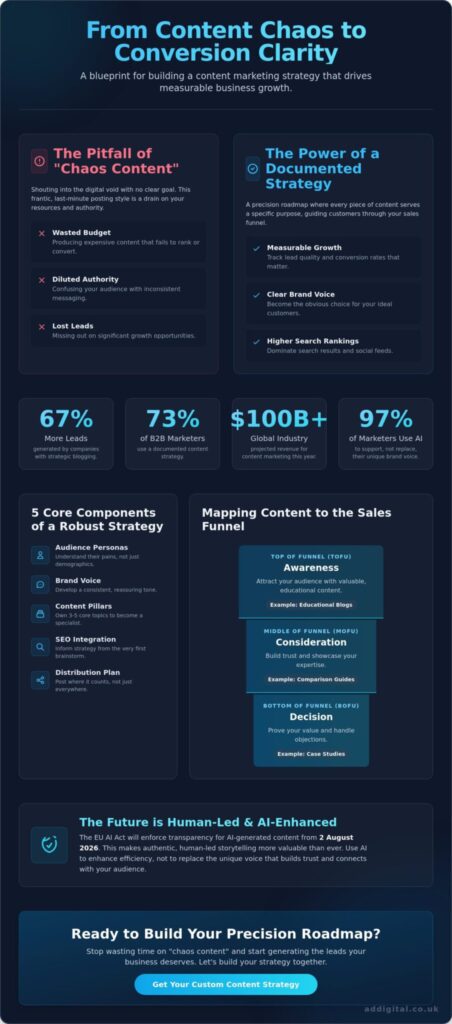
Think of your content as a GPS for business growth. Without a map, you’re just burning fuel and driving in circles. In 2026, 73% of B2B marketers use a documented plan because they’ve learned the hard way that “chaos content” doesn’t pay the bills. Chaos content is that frantic, last-minute posting style that lacks a clear goal. It’s the trap of shouting into the digital void and hoping someone hears you. Effective What is Content Marketing strategies are the antidote to this noise. They ensure every post, video, and email serves a specific purpose in your sales funnel.
Consistency is the food and drink of digital authority. If you show up inconsistently, your audience will quickly find a competitor who doesn’t. By 2 August 2026, the EU AI Act will enforce strict transparency for AI-generated content. This makes human-led storytelling more valuable than ever. Whilst 97% of marketers now use AI to support their work, the most successful content marketing strategies are those that use tools to enhance, not replace, a unique brand voice. People want to buy from people, not from an unmonitored algorithm.
Strategy vs. Marketing: Knowing the Difference
Strategy is your “why” and “how.” Marketing is the “do.” You wouldn’t start a construction project without a blueprint, so don’t start a YouTube channel without a plan. A robust strategy must come before any creative work. The ADDIGITAL way involves aligning your business goals with the content you produce. It’s about making sure your energy is spent on things that actually move the needle rather than just looking busy on social media. We help you bridge the gap between having a good idea and actually making that idea generate revenue.
The Real Cost of Poorly Planned Content
Poor planning isn’t just annoying; it’s a drain on your bank account. You might waste thousands of pounds on high-production videos that get zero views because they lack a distribution plan. When your content feels like a jumble, your brand looks amateur. This dilutes your authority and makes potential customers hesitate. The costs of a weak plan include:
- Wasted budget: Producing expensive content that doesn’t rank on Google or convert visitors.
- Diluted authority: Confusing your audience with inconsistent messaging across different platforms.
- Lost leads: Missing out on the 67% lead increase that strategic blogging provides to companies with a plan.
Shouting into a void is exhausting. We’re here to help you turn that noise into a clear, compelling conversation that builds trust and drives sales. It’s about working smarter, not harder.
The Core Components of a Robust Content Strategy
A successful plan isn’t built on guesswork. It’s built on a foundation of data and empathy. To move the needle, your content marketing strategies must integrate five core elements: audience personas, brand voice, content pillars, SEO, and distribution. If any of these are missing, your content will likely fall flat. You need to identify 3-5 core topics that your business can truly own. This prevents you from becoming a “jack-of-all-trades” and instead positions you as a specialist in your field. SEO isn’t an afterthought either. It must inform your strategy from the very first brainstorm to ensure your “food and drink” content actually reaches the people who need it.
Defining Your National Audience Persona
Demographics tell you who your customer is, but “pains” tell you why they buy. In the UK, business owners are often wary of over-promised results and technical jargon. They are looking for the “Job to be Done”—a specific solution to a frustrating problem. Whether it’s a shop owner in Tameside or a service provider in London, they value a supportive and reassuring tone over cold, clinical tech-speak. By addressing their specific objections early, you create a partnership before they’ve even clicked “contact.”
Mapping Content to the Sales Funnel
Many strategies fail because they only focus on the Top of Funnel (TOFU). Whilst educational blogs are great for awareness, they won’t close the deal on their own. You need Middle of Funnel (MOFU) content like comparison guides to build trust. Most importantly, your Bottom of Funnel (BOFU) content must act as your best salesperson. This is where you handle objections head-on. If you can prove your reliability through case studies and clear proof points, the final conversion becomes inevitable. If you’re struggling to align these stages, our bespoke digital services can help you map out a journey that turns strangers into loyal clients.
With YouTube Shorts crossing 70 billion daily views in 2026, your distribution plan cannot be static. You must choose channels where your audience actually spends their time. Don’t just post everywhere; post where it counts. This focused approach ensures your budget is spent on engagement rather than just digital noise. We’re here to ensure your message doesn’t just look good but actually works for your business.
Choosing the Right Content Formats for Your Business
Not all formats are created equal. You need a mix that balances long-term SEO with immediate social buzz. Whilst some chase every new trend, the best content marketing strategies focus on high-ROI channels. For instance, companies with active blogs generate 67% more leads every month compared to those without. This isn’t a coincidence; it’s the result of building a robust digital footprint that answers customer questions before they even ask them.
Short-form video is the undisputed king of social engagement in 2026. With TikTok reaching over 2.20 billion monthly users by the end of this year, you can’t afford to ignore “short and punchy” clips. Meanwhile, email marketing remains the Premier League of direct engagement. It’s your private channel to talk to customers without an algorithm getting in the way. Are your current emails actually performing? If not, it’s time to rethink your approach and focus on what works.
- Long-form blogs: These build your SEO equity and establish you as a trusted authority.
- Short-form video: Use YouTube Shorts, which have crossed 70 billion daily views, to capture attention quickly.
- Email marketing: The most direct way to nurture leads and drive repeat business.
- Infographics: These make complex technical concepts intuitive and easy to share.
The Enduring Value of Written Content
Your website needs a knowledge centre. Think of yourself as a digital craftsman, building a library of expertise that solves real problems for your local community. Break your text up with H2s, H3s, and bullet points so it’s easy to skim on a mobile. Evergreen content is a high-ROI asset that continues to provide value and attract traffic long after its initial publication date. This approach ensures your content marketing strategies deliver results for years, not just days.
Visual and Audio: Engaging the Senses
Video lets you humanise your brand. It’s about “turning coffee into websites” and showing the real people behind the screen. Podcasts are also booming in 2026, helping you establish thought leadership amongst peers whilst they commute or work. Don’t let your hard work go to waste. You can easily repurpose one long-form article into five social media snippets to keep your feed active without the burnout. This keeps your brand at the front of your customers’ minds without needing a massive production team.
A Step-by-Step Guide to Executing Your Strategy
Execution is where the rubber meets the road. Even the most brilliant content marketing strategies are useless if they sit in a folder gathering digital dust. To turn your ideas into revenue, you need a clear, repeatable process. Don’t try to do everything at once. Start by looking at what you already have. A thorough content audit helps you identify which website assets are performing and which need a trip to the bin. You might find a blog post from three years ago that just needs a quick update to start ranking again.
Once you know your starting point, set SMART goals. Vague ambitions like “getting more traffic” won’t help your bottom line. Instead, aim for something concrete, such as “Increase Shopify leads by 20% in Q3.” This gives your team a clear target to hit. Following this, use professional tools like Semrush or Ahrefs to find the terms your audience is actually searching for. Finally, create a realistic calendar and stick to it. Producing content is only half the battle; you must spend 80% of your time promoting it to ensure it reaches the right eyes. If you want to stop guessing and start growing, our team can help you organise your digital marketing for maximum impact.
Keyword Research: The Foundation of Discovery
Success starts with finding “low-hanging fruit” keywords that your competitors have missed. Don’t just chase high-volume terms that are impossible to rank for. Focus on search intent. Are users looking for information, or are they ready to buy? By organising your topics into clusters, you build topical authority that tells search engines you really know your stuff. This makes it much easier to climb the rankings whilst providing genuine value to your visitors.
The Content Calendar: Staying Consistent
Consistency is your best friend. You don’t need complex, expensive project software to stay on track. A simple spreadsheet often works better because it’s easy to manage and share. Your calendar should balance “hero” content, like in-depth guides, with regular, smaller updates that keep your brand active. Remember to plan for seasonal trends and industry-specific events well in advance. This ensures you’re never scrambling for ideas at the last minute. We take a no-nonsense approach to scheduling because we know that a plan you can actually follow is the only one worth having.
Measuring Success and Scaling Your Results
Stop chasing “likes.” They don’t pay the bills. If your content marketing strategies aren’t moving people closer to a purchase, they’re just expensive hobbies. In 2026, the global content marketing industry is projected to surpass $100 billion in revenue, but much of that is wasted on vanity metrics. Real success is measured by lead quality and conversion rates. Are visitors staying on the page? Are they clicking your call-to-action buttons? A bespoke WordPress or Shopify site makes this tracking intuitive. When your content and your platform work together, you stop losing the 60 hours annually that many businesses waste on inefficient tools and broken tracking links.
We’ve been in business since 1999, and we’ve seen every trend come and go. The one constant is that data doesn’t lie. If your time-on-page is low, your content isn’t engaging. If your lead quality is poor, your audience persona is off. It is about making things work better rather than just looking good. By focusing on the numbers that actually impact your bottom line, you can scale your efforts with confidence and precision.
Key Metrics That Actually Matter
Organic traffic growth is your climb up the “league tiers.” Moving from the National League to the Premier League of search results takes time, but the rewards are massive. Track your Click-Through Rate (CTR) from the search engine results pages to see if your headlines are actually hooking people. Don’t ignore assisted conversions. Often, a customer might read three of your blogs before they finally decide to buy. That content provided the “assist” that made the final goal possible. Recognising this journey is the only way to measure the true ROI of your efforts.
Partnering for Professional Growth
Scaling requires more than just more coffee. It requires a partner who understands the technical side of the digital world. “We’ve got you” isn’t just a slogan; it’s how we handle the heavy lifting of technical SEO and hosting whilst you focus on running your business. There comes a point where DIY content creation hits a ceiling. When you’re ready to produce fewer, higher-quality pieces that actually rank, it’s time to consider professional help. We are digital craftsmen who take your success very seriously. Let ADDIGITAL help you craft a winning content strategy that delivers more than just empty engagement and turns your digital presence into a booming lead generator.
Ready to Turn Your Content into a Growth Engine?
Building effective content marketing strategies in 2026 isn’t about working harder; it’s about being more intentional with every word you publish. You’ve seen how a documented plan can transform “chaos content” into a lead-generating machine that respects the new transparency laws starting 2 August 2026. By focusing on the core topics your business truly owns and mapping them to the buyer journey, you stop shouting into a void and start building real trust with your audience. It’s time to move past vanity metrics and focus on the results that actually impact your bottom line.
We’ve been helping businesses succeed online since 1999. As digital craftsmen, we specialise in bespoke WordPress and Shopify solutions that make tracking your ROI intuitive and straightforward. Our no-nonsense approach ensures your website isn’t just a digital brochure but a robust tool for growth. You don’t have to navigate these technical shifts alone. We’ve got the expertise to ensure your brand voice remains consistent and compelling across every platform.
Ready to grow? Discover “The ADDIGITAL way” to content marketing today. Let’s get your business moving toward that Premier League status. Your future customers are waiting for a brand they can trust; let’s make sure it’s yours.
Frequently Asked Questions
What is the most effective content marketing strategy for a small business?
The most effective approach for a small business involves building content marketing strategies that focus on niche authority and solving specific customer pains. Instead of trying to compete with global giants, focus on being the “local expert” or the “specialist craftsman” in your field. High-value, educational content that answers your customers’ most common questions will build trust far faster than generic sales pitches. This targeted focus ensures your limited budget is spent on attracting leads who are actually ready to buy.
How long does it take to see results from content marketing?
You should expect to see meaningful organic results within 6 to 12 months of consistent activity. Whilst short-form video on platforms like TikTok can occasionally spark quicker engagement, building true search engine authority is a long-term play. Remember that 73% of B2B marketers use a documented plan because they know consistency is the only way to win. It is a marathon, not a sprint, but the 67% increase in monthly leads from active blogging makes the wait worthwhile.
Can I do content marketing myself or should I hire an agency?
You can certainly start content marketing yourself, but hiring an agency becomes essential when you need to scale or handle technical complexities. Many small business owners find they can manage a few posts, but they eventually hit a ceiling where they can’t maintain quality or track ROI. An agency acts as a digital partner, handling everything from technical SEO to the EU AI Act compliance due on 2 August 2026. This frees you up to focus on running your business whilst the experts handle the growth.
How much should a business spend on content marketing in 2026?
In 2026, content marketing budgets have risen to an average of 26% of total marketing spend. This shift reflects the growing importance of owned media over increasingly expensive paid ads. There is no one-size-fits-all price tag, but successful businesses treat this spend as an investment in a long-term asset rather than a one-off cost. Whether you are in the “National League” or the “Premier League” of your industry, your budget should scale alongside your growth goals.
What is the difference between a content strategy and a content plan?
A strategy is your high-level roadmap that aligns your content marketing strategies with your business objectives. It defines who your audience is, what problems you solve for them, and why they should choose you over a competitor. A content plan, on the other hand, is the tactical execution of that strategy. It is your calendar of what you’ll publish, where you’ll post it, and when it will go live. You need both to avoid the trap of “chaos content.”
How often should I publish new content on my website?
Quality always beats quantity, so aim for 1 to 2 high-quality, in-depth pieces per week rather than daily filler. Marketers in 2026 report significantly better results from publishing fewer, well-researched articles that provide genuine value. If you can only produce one excellent post a month, that is better than four mediocre ones that nobody wants to read. Focus on being the most helpful resource in your industry and the search rankings will follow.
Is social media marketing the same as content marketing?
Social media is a distribution channel, whereas content marketing is the creation of the valuable assets themselves. Think of your website content as the “food and drink” and social media as the waiter who delivers it to the table. Whilst social media is great for engagement, you don’t own those platforms. A robust strategy ensures you are driving that social traffic back to your own website, where you have full control over the user experience and the conversion process.


