

Why does one developer quote you £500 whilst another asks for £5,000 for what looks like the exact same website? It is the most frustrating question in digital marketing, especially when you are just trying to figure out how much should a small business website cost uk in 2026. With 70% of customers now researching small businesses online before they ever step foot in a shop, getting this investment right is the difference between a booming brand and a digital ghost town.
We understand the fear of being stuck with a “cheap” DIY platform you will outgrow in six months or getting hit by hidden fees that appear out of nowhere. This guide provides a clear, no-nonsense breakdown of the 2026 pricing landscape, from £500 template starters to £40,000 e-commerce powerhouses. We will explain the latest May 2026 E-commerce Regulations, reveal the true cost of managed hosting, and show you how to budget for a site that delivers a genuine return on investment the ADDIGITAL way.
Key Takeaways
- Shift your focus from upfront expense to long-term ROI by treating your website as your brand’s only true digital headquarters.
- Get a clear answer to how much should a small business website cost uk by using our simple “Football League” tier system to match your budget to your goals.
- Identify and avoid common “maintenance traps” like cheap hosting and overlooked security fees that can cripple your site’s performance.
- Follow a proven five-step budgeting process to ensure your investment translates into tangible leads and sales.
- Leverage over 25 years of local expertise to get bespoke, high-performance web design without paying inflated London agency prices.
Understanding the UK Web Design Landscape in 2026
Stop thinking about your website as a digital business card. It is your Digital Headquarters. Think about it; you don’t own your Facebook page, your TikTok profile, or your Instagram feed. You are merely renting space on those platforms. If an algorithm changes or a platform vanishes, your “rented” audience goes with it. Your website is the only piece of digital real estate you truly own. In May 2026, with generic AI-generated sites flooding the internet, having a site with bespoke craftsmanship is your best way to stand out from the noise.
When business owners ask how much should a small business website cost uk, they are usually looking for a fixed price list. However, that is the wrong question to start with. The real question is: what is the return on investment (ROI)? You have three primary paths to choose from. You can use a DIY builder (the National League), hire a freelancer (the Football League), or partner with a professional agency (the Premier League). Each path offers different levels of support, scalability, and results.
Why Price Variance is So High Amongst UK Agencies
Price gaps in the UK market are massive, and for good reason. A “bedroom” freelancer has almost zero overheads, which reflects in a lower quote. However, an established digital agency provides a collective of experts in coding, security, and understanding the web design process. Choosing a £500 “off-the-shelf” template might seem like a bargain today. Unfortunately, these sites often lack the flexibility your business needs as it grows. We frequently see clients spending £5,000 to rebuild a site two years later because their cheap starter site couldn’t handle new traffic or basic security updates.
Your Website as a Revenue Driver, Not a Cost Centre
Shift your perspective. Your website is not a bill to be paid; it is a 24/7 salesperson who never takes a sick day. When we build a site, we don’t just look at the aesthetics. We integrate Search Engine Optimisation (SEO) and conversion rate optimisation (CRO) into the very foundation. This ensures your site doesn’t just look pretty but actually converts visitors into paying customers. Value-Based Pricing is the alignment of cost with business growth goals. By investing in quality now, you are building a robust tool designed to scale alongside your ambitions.
The Three Tiers of Website Investment: Which League are You In?
Budgeting for a new site shouldn’t feel like a shot in the dark. To help our clients make sense of the market, we categorise web design into a “Football League” system. This makes it easy to see where your business sits and what level of performance you are actually buying. When you ask how much should a small business website cost uk, the answer depends entirely on which league you want to play in. Are you just finding your feet in the National League, or are you ready for a Premier League presence that dominates your competitors?
Tier 1: The DIY and Template Route (£10 – £50 per month)
This is the National League of web design. It is perfect for sole traders or hobbyists following the official UK government business setup guide who have more time than spare cash. In 2026, platforms like Wix and Squarespace offer slick AI builders that can get you online in an afternoon. However, the “Time Cost” is the real killer here. If you spend 30 hours wrestling with a template, and your time is worth £50 an hour, that “cheap” site has already cost you £1,500 in lost productivity. You also lose out on bespoke SEO and the unique brand identity that makes customers choose you over the person down the road.
Tier 2: The Freelance Professional (£1,500 – £3,500)
Welcome to the Football League. This tier is for growing SMEs that need a personalised touch but aren’t ready for a full agency team. You get a human being to talk to and a site that usually outperforms any DIY builder. Expect a professional build of 5 to 10 pages with basic integrations for your emails or booking systems. The risk here is the “single point of failure”. If your freelancer goes on holiday, gets sick, or decides to change careers, your technical support disappears overnight. It is a solid step up, but it lacks the long-term security of an established firm.
Tier 3: The Bespoke Digital Agency (£5,000 – £15,000+)
This is the Premier League, where high-growth brands live. You aren’t just paying for a website; you are investing in a comprehensive digital strategy. This tier includes custom WordPress or Shopify development, professional content creation, and advanced security protocols. This is the ADDIGITAL way. We take your business goals, add a healthy dose of caffeine, and turn them into robust, intuitive platforms that scale. If you want a site that handles thousands of visitors without breaking a sweat, our bespoke builds are designed to deliver a genuine return on investment. You get a team of experts that has been around since 1999, ensuring your “Digital Headquarters” is always open for business.
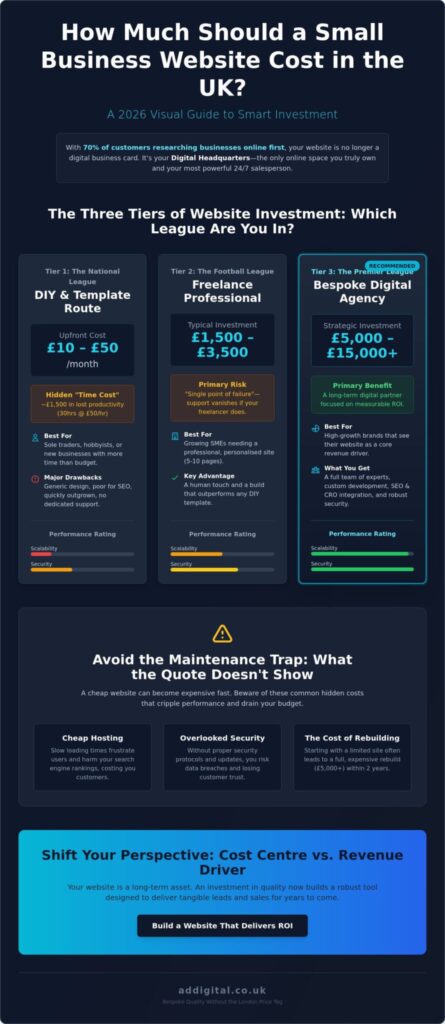
Hidden Costs and the Maintenance Trap: What the Quote Doesn’t Show
Imagine buying a brand new van but forgetting you need insurance, fuel, and an annual MOT. Many people asking how much should a small business website cost uk make this exact mistake with their digital presence. The initial build is just the start. If you ignore the ongoing requirements, your shiny new site will quickly become a liability rather than an asset. From security patches to hosting performance, the “Maintenance Trap” is where many cheap projects eventually fail. You wouldn’t leave your physical shop unlocked overnight, so why do it with your digital headquarters?
The True Cost of Web Hosting and Upkeep
Cheap hosting is a false economy. It often means your site shares a server with thousands of other businesses, leading to sluggish speeds and frequent downtime. Slow sites frustrate users and kill your conversion rates. At ADDIGITAL, we prioritise secure, reliable hosting because we know that a one-second delay can drop your sales by 7%. Beyond hosting, your site needs regular “health checks”. WordPress plugins and themes require constant updates to stay secure. Ignoring these is an open invitation for hackers. Budgeting for managed maintenance ensures your site stays robust, intuitive, and, most importantly, online. Whilst you might have a clear idea of the essential pages for a small business website, those pages won’t serve you if the underlying tech is neglected.
Marketing and SEO: The Fuel for Your New Website
A beautiful website is useless if it sits on page 10 of Google. Nobody goes there. Many business owners confuse an “SEO-friendly” build with an “Ongoing SEO” strategy. An SEO-friendly build means the code is clean and Google can read it. Ongoing SEO is the active work required to outrank your competitors. This includes content creation, link building, and technical tweaks. We recommend allocating 20% to 30% of your initial budget for launch marketing. This ensures people actually find your site once it goes live. Without this “fuel”, your new investment will just sit in the digital garage gathering dust. We focus on making things work better, not just looking good, which is why we build marketing into the conversation from day one. It is the only way to ensure your site becomes a genuine revenue driver.
How to Budget for Your Small Business Website: 5 Steps to ROI
Budgeting is about strategy, not just numbers. When you are trying to calculate how much should a small business website cost uk, you shouldn’t just look at the bottom line of a quote. You need to look at what that money actually buys you in terms of growth. Around 92% of small business owners believe a website is their most effective digital marketing tool, yet many fail because they don’t plan for the return. Understanding how much should a small business website cost uk becomes much clearer when you view it through the lens of a five-step plan designed to protect your cash flow and maximise your results.
- Step 1: Define your primary goal. Is your site there to generate phone calls, sell products directly, or simply provide credibility? A lead-generation site for a local plumber has very different requirements than a high-street boutique’s online store.
- Step 2: Audit your current assets. Do you have high-quality photography and professionally written copy? If not, you need to budget for content creation. Your site is only as good as the “food and drink” you feed it.
- Step 3: Choose the right platform. Don’t get trapped in a system that doesn’t fit your business model. We generally recommend WordPress for flexibility or Shopify for pure e-commerce power.
- Step 4: Vet your partners. Look for longevity. We have been turning coffee into websites since 1999. A partner with a 25-year track record reduces your project risk significantly compared to a start-up agency.
- Step 5: Define a Phase 1 launch. You don’t need every bell and whistle on day one. Launching a high-quality “Minimum Viable Product” allows you to start ranking on Google whilst managing your initial investment.
Choosing Between WordPress and Shopify
WordPress remains the king of flexibility. It is our go-to for service-based businesses that need robust SEO and the ability to scale their content. If you are one of the 59 million e-commerce users in the UK, Shopify is often the better choice. It is built specifically for selling and handles the technical heavy lifting of security and payments. Your platform choice dictates your long-term cost of ownership, so pick the one that matches your three-year growth plan, not just your three-month budget.
Questions to Ask Your Web Design Partner
Don’t sign anything until you have clear answers to these three questions. First, do I own the site and domain outright? Some agencies “rent” sites to you, which is a disaster if you want to leave. Second, is the design bespoke or just a modified template? You don’t want a site that looks like every other business in Tameside. Finally, what happens if I want to move to a different host later? A professional partner will make this process easy. If you want a team that values transparency as much as quality, book a discovery call with us to discuss your project goals.
The ADDIGITAL Way: Bespoke Quality Without the London Price Tag
Experience matters in a landscape that changes every week. We have been building for the web since 1999. In digital terms, that makes us veterans. This longevity is your biggest safety net. It means we have seen every trend, every algorithm update, and every “next big thing” come and go. When you are weighing up how much should a small business website cost uk, you are really paying for the certainty that your project won’t fall over in six months. We have spent over 25 years refining a methodology that eliminates project risk and focuses entirely on your bottom line.
Our “No-Nonsense” approach is exactly what it sounds like. We don’t hide behind technical jargon or try to sell you features you don’t need. We are digital craftsmen who understand that a website is a tool, not a trophy. Does it load quickly? Is it easy for a customer to buy from you? Does it represent your brand with professional confidence? These are the questions that drive our process. We turn coffee into websites that perform, ensuring every pound you invest works as hard as you do.
Why Bespoke Beats Templates Every Time
Many business owners start by asking how much should a small business website cost uk and end up choosing a cheap template to save money. This is often a mistake. Templates are built to please everyone, which means they are packed with “bloat” code that slows your site down. A bespoke build from ADDIGITAL is lean, fast, and secure. We build specifically for your needs, which offers several distinct advantages:
- Superior Speed: By eliminating unnecessary code, your site loads faster, which keeps both users and Google happy.
- Unique Identity: We tailor every layout and colour to your brand personality, ensuring you stand out amongst competitors who use the same tired templates.
- Clean Coding: Our digital craftsmanship means your site is robust and less vulnerable to the security flaws often found in mass-produced themes.
Ready to Invest in Your Digital Headquarters?
A professional website is the most important investment you will make for your business in 2026. It is your 24/7 salesperson and your only true digital headquarters. Whilst the initial price tag is important, the three-year ROI is what really defines success. Don’t settle for a site that just looks pretty; choose a platform that is built to scale and designed to convert. We don’t just build and bolt. We stay with you as partners to support your growth and ensure your digital presence remains a booming asset. Are you ready to take your business to the next level? Book a consultation with the ADDIGITAL team today and let’s get to work.
Secure Your Digital Future with a Site That Scales
Your website is much more than just a line item on a spreadsheet; it is the digital foundation of your entire business. We have explored the different leagues of investment and the hidden traps that can turn a cheap starter build into a very expensive mistake later on. Understanding how much should a small business website cost uk is ultimately about more than just comparing bottom-line quotes. It is about choosing a partner who understands that your “Digital Headquarters” needs to be a robust, 24/7 salesperson that never takes a day off.
Since 1999, our team has helped UK businesses skip the “template bloat” and build high-performing platforms. As bespoke WordPress and Shopify experts, we provide a no-nonsense, results-driven approach that ensures you get premium quality without the inflated London price tags. You don’t have to navigate the complexities of 2026 regulations or technical maintenance alone. We’ve got you covered every step of the way, from the first line of code to your successful launch and beyond. Ready to stop guessing and start growing?
Get a bespoke quote for your project from the ADDIGITAL team
Your business deserves a site that works as hard as you do. Let’s build something brilliant together.
Frequently Asked Questions
How much does a 5-page small business website cost in the UK?
A 5-page small business website typically costs between £500 and £2,500 for a template-based build in 2026. If you require a custom-designed site tailored specifically to your brand, prices generally range from £2,500 to £10,000. This investment covers the core build, but remember that high-quality content and professional photography are often extra. Choosing the right tier ensures you don’t overpay for features you won’t use.
Is it cheaper to use a website builder or hire a professional?
Using a website builder is cheaper in the short term, with monthly fees often under £30. However, hiring a professional is usually more cost-effective over a three-year period. Professionals build sites that actually convert visitors into customers, whereas DIY sites often lack the technical SEO and user experience needed to rank. You save money on the build but lose money on missed sales opportunities. It is a classic “time vs money” trade-off.
What are the ongoing costs of running a website in 2026?
Expect to pay around £10 per year for a .co.uk domain and between £120 and £300 annually for high-quality hosting. Managed WordPress maintenance typically costs between £150 and £350 per month in 2026. These fees cover essential security updates, backups, and technical support. Neglecting these ongoing costs is a major risk; it is like owning a car and never paying for a service or MOT.
Do I really need a bespoke website or will a template do?
A template might suffice for a new start-up, but a bespoke site is the gold standard for growth. Bespoke designs eliminate the “bloat” code found in generic themes, leading to faster loading times and better security. When asking how much should a small business website cost uk, consider that a bespoke site reflects your unique brand personality. It ensures you aren’t just another face in the crowd with a site that looks like everyone else’s.
How long does it take to build a professional small business website?
A professional small business website usually takes between 4 and 12 weeks to complete. A simple “National League” starter site might be ready in a month, whilst a complex “Premier League” e-commerce build often requires three months of development. This timeline includes strategy, design, coding, and testing. Rushing the process often leads to mistakes, so we prioritise a thorough approach that ensures your digital headquarters is robust from day one.
Can I update the website myself once it is built?
Yes, you can easily update the website yourself if it is built on a user-friendly Content Management System (CMS) like WordPress or Shopify. We ensure our clients are fully trained to change text, swap images, and add blog posts without needing a developer. This flexibility is a core part of the ADDIGITAL way. It puts you in control of your digital presence whilst we handle the complex technical heavy lifting in the background.
Why is WordPress often recommended for small businesses?
WordPress is recommended because it powers 43% of all websites and offers unmatched flexibility. It is an open-source platform, meaning you truly own your site and can move it to any host you choose. For small businesses, the massive library of plugins and strong SEO foundation make it a robust choice. It scales as you grow, taking you from a local start-up to a national player without needing a total rebuild.
Is SEO included in the cost of a new website?
Technical SEO is usually included in the initial build, but ongoing strategy is a separate service. When calculating how much should a small business website cost uk, you should budget for both the “SEO-friendly” foundation and a monthly retainer for content and link building. A site without an ongoing strategy is like a sports car without fuel; it looks great in the driveway but won’t take you anywhere on Google’s search results.


