
Users form a credibility opinion about your website in just 0.05 seconds, so knowing the right questions to ask a web design agency is the difference between a lead-generating machine and a waste of budget. We know the fear of being locked into a proprietary system or getting hit with hidden post-launch costs that weren’t in the initial quote. You want a site that generates leads, not a digital paperweight that’s impossible to manage yourself.
We’ve been turning coffee into websites since 1999, so we’ve seen every trick in the book. This guide provides the definitive checklist to help you vet partners with confidence. You’ll learn how to avoid expensive mistakes, ensure you own your digital assets, and check if an agency is ready for the WordPress 7.0 release on 20 May 2026. From technical SEO to WCAG 2.1 AA accessibility, we’re giving you the framework to find a “Premier League” partner who actually delivers results.
Key Takeaways
- Master the discovery phase to ensure your site is a bespoke business tool rather than a generic, restyled template.
- Use our checklist of questions to ask a web design agency to avoid the “ownership trap” and secure your digital assets on flexible platforms like WordPress.
- Shift your focus from “pretty” design to performance by learning how to spot an actual SEO strategy that generates real-world leads.
- Protect your investment by identifying red flags like hidden maintenance fees or “guaranteed” rankings that sound too good to be true.
Strategy and Discovery: Vetting Their Creative Process
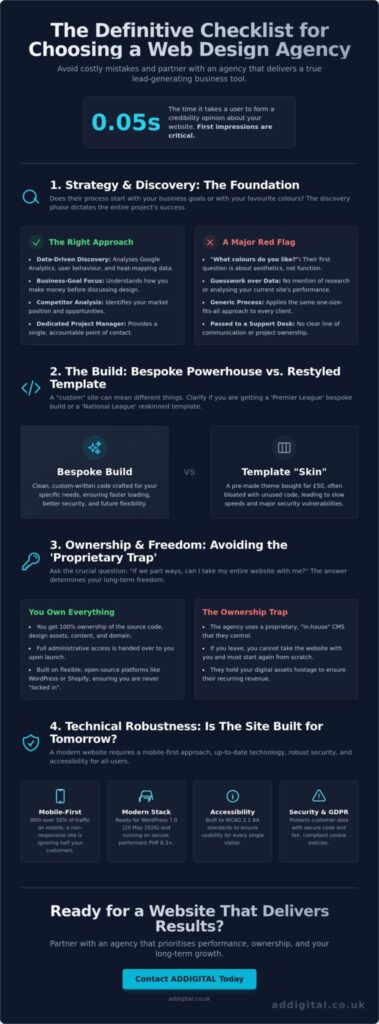
The discovery phase is the foundation of your entire project. If an agency starts by asking what colours you like before they’ve asked how you actually make money, they’re doing it wrong. We’ve seen it a thousand times since 1999; projects that skip the strategy phase always end up as expensive digital paperweights. This initial research is where we identify your “Premier League” goals and map out a plan to reach them. One of the most critical questions to ask a web design agency is how they intend to bridge the gap between your current site and your business objectives.
A website is a functional business tool, not an art project. To truly succeed, your partner needs to understand the fundamentals of web design and how they apply to your specific niche. They should be looking at your competitors, analysing your current traffic data, and identifying where your visitors are dropping off. Users form a credibility opinion about your business in just 0.05 seconds. If the strategy isn’t right from the first millisecond, you’ve already lost the lead.
Do You Build Bespoke or Use Templates?
This is where the “no-nonsense” approach is vital. Many agencies claim to build custom sites whilst they’re actually just “skinning” a pre-made template they bought for £50. Templates are the “National League” of web design; they’re bloated, slow, and restrictive. A bespoke build is crafted specifically for your brand. It ensures faster loading times and better security. Ask them directly if they use a “starter theme” or if they write their own code. If they can’t show you a clean codebase, they aren’t the digital craftsmen you’re looking for.
What Is Your Research and Discovery Process?
The ADDIGITAL way starts with data, not guesswork. You need to know if the agency will review your Google Analytics or conduct heat-mapping to see how customers behave on your current pages. We’re focused on making things work better, which means understanding your industry inside out. You should also clarify who your main point of contact is. Will you have a dedicated project manager, or are you being passed around a generic support desk? Knowing who is accountable for your results is just as important as the design itself. We take our clients’ success seriously, and that starts with a clear, honest line of communication from day one.
Technical Robustness: Ownership, CMS, and Security
Technical robustness isn’t just about clean code; it’s about control and security. When compiling your list of questions to ask a web design agency, the infrastructure of your site should be a top priority. A site that looks “Premier League” on the surface can still be a “National League” disaster underneath if it’s built on shaky foundations. More than half of all websites are now viewed on mobile devices according to Netwave Interactive data from March 2026. If your agency isn’t prioritising a mobile-first architecture, they’re ignoring 50% of your potential customers from day one.
Security is another non-negotiable factor. With the release of WordPress 7.0 on 20 May 2026, the technical requirements have shifted. Your agency must ensure your server is running PHP 8.3 or greater to maintain performance and safety. We also see a massive focus on GDPR compliance and fair cookie banners that avoid “dark patterns.” A truly professional partner won’t just build a site; they’ll build a fortress that protects your customer data and your reputation. If you want to see how we handle these technical hurdles, you can explore the ADDIGITAL way to building secure, high-performance sites.
Who Owns the Website and the Content?
The “Ownership Trap” is a common nightmare for UK SMEs. Some agencies use proprietary “in-house” systems that essentially hold your business hostage. If you decide to move to a different provider, you can’t take the code with you. You’re forced to start from scratch. You must ask: “If I leave, can I take my website with me?” Full ownership of the domain, the design assets, and the source code is a non-negotiable legal requirement for any business. Ensure you have full administrative access to your CMS and hosting account from the moment the site goes live. Anything less is a major red flag.
Which Platform Do You Use and Why?
We champion open-source platforms like WordPress and Shopify because they offer unmatched flexibility. WordPress currently powers over 40% of the web, and the upcoming 7.0 version will introduce real-time collaboration features that make managing your content easier than ever. For e-commerce, Shopify remains the gold standard for reliability and scale. Avoiding proprietary systems means you’re never “locked in” to one developer. If your agency insists on a system they built themselves, they’re likely prioritising their own recurring revenue over your long-term business agility. Stick to global standards that allow your business to grow without artificial boundaries.
Performance and Growth: SEO and Lead Generation
A stunning website that sits on page ten of Google is just a very expensive digital business card. We don’t build art; we build tools for growth. One of the most vital questions to ask a web design agency is whether they prioritise performance over aesthetics. Every £1 you invest in User Experience (UX) design returns an average of £100 according to Naveck Technologies research from 2026. If your agency cannot explain how they will achieve that return, they’re simply guessing with your budget.
We’ve seen too many business owners get “hooked” by a flashy portfolio, only to find their new site has zero visibility. Real growth requires a blend of technical speed and strategic content. Google’s Core Web Vitals are now a primary ranking factor. Your site needs to load instantly and behave predictably across all devices. Since users form an opinion on your credibility in just 0.05 seconds, a slow site doesn’t just hurt your rankings; it kills your reputation before the first paragraph even loads.
Is Basic SEO Included in the Build?
Don’t settle for vague promises like “we make it SEO-friendly.” That phrase is often code for doing the bare minimum. You need specifics. Ask if they’ll handle meta tags, alt text for images, and a logical site structure that search engines can actually crawl. If you’re replacing an old site, 301 redirects are essential. Without them, you’ll lose every bit of hard-earned authority your previous site built up over the years. We also look at content; will they help you create compelling copy that ranks, or are you expected to provide it all yourself?
How Do You Optimise for Conversions?
Traffic is only half the battle. You need that traffic to do something. This is where Conversion Rate Optimisation (CRO) comes in. The ADDIGITAL way involves mapping out the entire user journey before we even open a design tool. We look at where your clear calls to action (CTAs) will sit and how lead magnets can be integrated to capture data. When considering which questions to ask a web design agency, always push for details on how they track success. A “Premier League” agency will set up Google Analytics and Search Console as standard. They’ll show you exactly how people are interacting with your site so you can make data-driven decisions rather than relying on gut feelings. It’s about turning visitors into customers, not just keeping them entertained.
The Long-Term Relationship: Maintenance and Support
Launch day is a milestone, but it isn’t the finish line. It’s actually the start of the race. One of the most overlooked questions to ask a web design agency is what happens once the final invoice is paid. Websites are living digital assets that require constant care to remain secure and performant. According to 2026 industry standards, businesses should budget 10-15% of their initial build cost for annual maintenance. If an agency suggests you can “set and forget” your site, they’re setting you up for a technical failure down the road.
We’ve been supporting clients since 1999, so we know that a broken plugin or a server error can cost you thousands in lost leads. Reliable, UK-based hosting is your first line of defence. Hosting your site on local servers ensures faster loading speeds for your UK audience and means support is available during your working hours, not in the middle of the night. We believe in building robust foundations that don’t just look pretty but stay standing through every update and traffic spike.
What Happens After the Site Goes Live?
You shouldn’t be held hostage by your developer for every minor tweak. A “Premier League” agency will provide training so you can organise your own content updates and blog posts. Ask about their typical response time for support requests. Is it four hours or four days? You also need to know if software and plugin updates are included in your hosting fee. With WordPress 7.0 launching on 20 May 2026, having a partner who proactively manages these transitions is vital for your site’s security and longevity.
Can You Scale the Site as My Business Grows?
Your business won’t look the same in three years, and your website shouldn’t either. You need a foundation that allows for easy expansion, whether that’s adding an e-commerce shop or integrating sophisticated Google Ads landing pages. We focus on building sites that grow with you, ensuring you aren’t forced into a costly rebuild just because you’ve hit a “booming” period of success. If you’re looking for a partner who takes your long-term success seriously, check out our web hosting and support packages to see how we keep our clients’ sites in top condition.
The Final Checklist: Red Flags and Next Steps
You’ve now gathered the most critical questions to ask a web design agency. This final stage is about separating the “Premier League” experts from the amateurs who might leave your project in the “National League” doldrums. Transparency is your best friend here. If an agency is cagey about their pricing or hides behind “secret” proprietary technology, it’s a massive red flag. We’ve been turning coffee into websites since 1999, and we know that a successful partnership is built on honesty, not technical jargon.
Reviewing a portfolio is about more than just looking at pretty pictures. You need to see functional success. Ask for examples of sites that actually generate leads or handle complex e-commerce transactions. A site that looks great but fails to convert is a failure. The ADDIGITAL way involves looking at the data first. We focus on making things work better, which is why our 25 years of experience delivering success for businesses nationwide matters. We don’t just build websites; we build business tools that last.
3 Red Flags to Watch Out For
- Agencies that don’t ask about your business: If they’re more interested in your colour palette than your profit margins, they’re just selling you a template. A real partner wants to know how you make money and who your customers are.
- “One-size-fits-all” pricing: Every business is unique. According to 2026 industry data, a small business website with 5-10 pages typically costs between £3,000 and £8,000. If an agency gives you a fixed price before a discovery phase, they’re guessing at your requirements.
- Lack of clear social proof: Don’t just take their word for it. Look for genuine client testimonials and case studies that show a measurable return on investment. If they can’t prove they’ve delivered results for others, they won’t deliver them for you.
How to Start Your Project with Confidence
Before you pick up the phone, organise your requirements. Know what you want your site to achieve and set a realistic budget. Remember that maintenance typically adds 10-15% to your initial build cost annually based on May 2026 market trends. Having these details ready helps us move quickly from the discovery phase to the booming phase. We take our clients’ success very seriously, and that starts with a no-nonsense conversation about your goals. Ready for a no-nonsense chat about your new website? Contact ADDIGITAL today.
Build a Website That Actually Works for Your Business
Hiring the wrong partner is an expensive mistake you don’t need to make. Armed with these questions to ask a web design agency, you now have the framework to vet potential partners with confidence. You know that discovery is the foundation, ownership is non-negotiable, and performance must be measured in leads, not just looks. With the WordPress 7.0 release on 20 May 2026 and stricter UK privacy regulations on the horizon, choosing a specialist who understands the changing technical landscape is vital.
We’ve been specialists in WordPress and Shopify since 1999, delivering a no-nonsense, results-driven approach that cuts through the technical jargon. We don’t just build sites; we craft digital tools that grow your business the “Premier League” way. If you’re tired of flakey freelancers and want a partner who takes your success as seriously as you do, let’s talk. Get a bespoke quote for your web design project and let’s turn some coffee into your new website. You’ve got the checklist; now it’s time to get moving.
Frequently Asked Questions
How much should a professional web design project cost in the UK?
A professional small business website with 5-10 pages typically costs between £3,000 and £8,000 in 2026. For e-commerce stores, prices generally range from £5,000 to over £40,000 depending on the complexity of your product catalogue. These figures are based on Naveck Technologies’ 2026 market report. You should also budget 10-15% of the initial build cost for annual maintenance to ensure your site remains secure and performant.
How long does it typically take to build a bespoke WordPress website?
A bespoke WordPress build usually takes between 8 and 12 weeks from the initial discovery session to the final launch. This timeline allows for the deep research and custom coding required for a “Premier League” business tool. Whilst template-based sites can be “skinned” in a fortnight, they lack the strategic foundation and speed optimisations necessary to dominate your local market.
Do I need to provide all the content and images for my new site?
You can provide your own materials, but we recommend professional content creation to ensure your site actually converts visitors into leads. High-quality imagery is vital because users form a credibility opinion in just 0.05 seconds. If you don’t have professional assets, we can source robust stock photography or help you organise a professional shoot that reflects your brand’s personality.
What is the difference between a freelance web designer and a digital agency?
A freelance designer is often a single specialist, whilst an agency provides a full team of experts across design, development, and SEO. Agencies offer greater longevity and reliability, with some like us operating since 1999. This is one of the most important questions to ask a web design agency because you need to be sure your partner won’t disappear if your site needs urgent support.
Will my new website be mobile-friendly and work on all devices?
Yes, every site we build uses mobile-first responsive design as standard to ensure it works perfectly on every screen. More than 50% of all websites are viewed on mobile devices according to Netwave Interactive data from March 2026. If your site isn’t optimised for smartphones, you are effectively ignoring half of your potential customers. We test across all major browsers to maintain a seamless user experience.
Can I update the website myself once it is finished?
You will have full administrative access to your CMS so you can update text, images, and blog posts yourself. We use intuitive platforms like WordPress or Shopify that make management straightforward for non-technical users. The ADDIGITAL way includes providing training for your team upon launch. You won’t be “locked in” or forced to pay us for every minor spelling correction or price change.
Why do I need a monthly maintenance or hosting plan?
Monthly maintenance keeps your site secure and compatible with the latest software releases like WordPress 7.0, which arrives on 20 May 2026. Without regular updates, your site becomes vulnerable to security threats and technical glitches that can kill your search rankings. Think of it as a “MOT” for your digital presence; it’s essential for maintaining a robust and reliable platform that lasts for years.
Do web design agencies also handle Google Ads and social media?
Many agencies handle Google Ads, social media marketing, and ongoing SEO to ensure your new site actually gets seen. A beautiful design is a great start, but it needs a consistent flow of traffic to generate a return on investment. We specialise in these growth services to help you build a “booming” digital presence. Integrating your marketing with your design ensures your brand voice remains consistent across every customer touchpoint.


